














Hiring one wrong person costs you, on average, $17,000. That’s not a scare tactic – that’s a SHRM estimate that most hiring managers quietly accept as true. And yet most companies are still running recruitment the same way they did in 2012: post a job, wait, manually sift through 200 resumes, interview six people, make an offer, repeat.
The ai hiring software benefits are becoming genuinely hard to ignore. Companies using AI-assisted tools are cutting time-to-hire by 40-60%, shrinking cost-per-hire, and – maybe more importantly – making better decisions with less guesswork.
So what does the ROI actually look like in practice? Specific numbers follow.
What Traditional Hiring Is Actually Costing You
Before talking about what you gain, it helps to be honest about what you’re losing.
The average time-to-hire sits around 44 days, according to LinkedIn’s data. Forty-four days. That’s a role sitting empty, work piling up, and existing team members stretched thin. Every extra week a position stays unfilled has a real productivity cost – estimates put it at $500-$1,500 per day for skilled roles.
Recruiter time is another drain that rarely gets measured properly. Studies show recruiters spend up to 40% of their working hours on manual resume screening. Not interviews, not sourcing, not anything strategic – just reading CVs. For a recruiter making $65,000/year, you’re effectively paying roughly $26,000 annually for the most mechanical part of their job.
And then there are the bad hires that slip through because someone screened 300 resumes in an afternoon and got fatigued by number 212. That one’s hard to put a number on. But you’ve probably felt it.
The Cost Savings Case for AI Hiring Tools
Here’s where things get concrete.
Straight hiring cost reduction is one of the most consistently documented ai hiring software benefits. When you automate screening, scheduling, and initial assessments, the hours your team spends on administrative work drop dramatically. A Deloitte study found organizations using AI in recruiting reduced their cost-per-hire by an average of 30%.
For a company hiring 50 people a year at $5,000 average cost-per-hire, that’s $75,000 back in your budget annually.
Some companies report bigger wins. Unilever cut their recruiting costs by $1 million per year after implementing AI video interviews for early-stage screening. Their hiring volume is massive, so your numbers won’t look like theirs – but the direction of the math holds at most scales.
The hiring cost reduction also compounds through speed. Every day a role gets filled faster means one less day of lost productivity. Compress a 44-day hire into 22 days and you’ve effectively doubled your pipeline velocity. For fast-growing teams, this compounds fast.
What you should actually track to measure your recruitment roi:
- Cost per hire (before and after implementation)
- Recruiter hours spent on screening
- Time-to-first-interview
- Time-to-offer
- Offer acceptance rate
If the tool isn’t moving at least two of these metrics, something’s wrong with your setup.
Speed: What a Faster Hiring Pipeline Looks Like
Speed is the ai hiring impact most teams feel first.
Without AI, the typical screening process looks like this: job goes live, applications roll in for two weeks, recruiter blocks off two days to screen, shortlist goes to the hiring manager, scheduling happens over email for another week. By the time first-round interviews are booked, it’s been 18 days since the job posted. Minimum.
With AI screening and automated scheduling, that first-round interview can happen in 48-72 hours. Candidates get assessed almost immediately. Shortlists are ready the same day the application window closes. The hiring manager gets a ranked list with notes, not a stack of PDFs and a vague “let me know what you think.”
That’s not just faster – it’s a meaningfully better candidate experience. Top candidates, the ones with real options, won’t wait three weeks to hear back. If you’re slow, they’ve already signed somewhere else. Speed is a competitive advantage in tight talent markets, and most hiring teams underestimate this badly.
ROI Comparison: Traditional vs. AI-Assisted Hiring
Here’s a rough breakdown for a company making 30-50 hires per year:
| Metric | Traditional Hiring | AI-Assisted Hiring | Typical Change |
| Average time-to-hire | 40-44 days | 18-25 days | 40-50% faster |
| Cost per hire | $4,500-$6,000 | $2,800-$4,000 | 25-35% lower |
| Recruiter screening hours per role | 6-8 hours | 1-2 hours | 70%+ reduction |
| Candidate drop-off rate | 35-45% | 15-25% | 10-20% improvement |
| Hiring manager quality rating | 6.5/10 | 7.5/10 | Measurable lift |
These are directional estimates based on published case studies from IBM, Hilton, and L’Oreal – all of whom have documented AI recruiting results publicly. Your mileage will vary depending on role type and industry.
The recruitment roi calculation is actually pretty simple once you have your baseline numbers. Take your current cost-per-hire, multiply by annual headcount, then estimate what a 25-30% reduction saves you. Add the productivity value of faster time-to-hire. Compare against the annual tool cost. For most teams doing 30+ hires a year, the math turns positive inside the first quarter.
How AI Hiring Improves Recruitment ROI
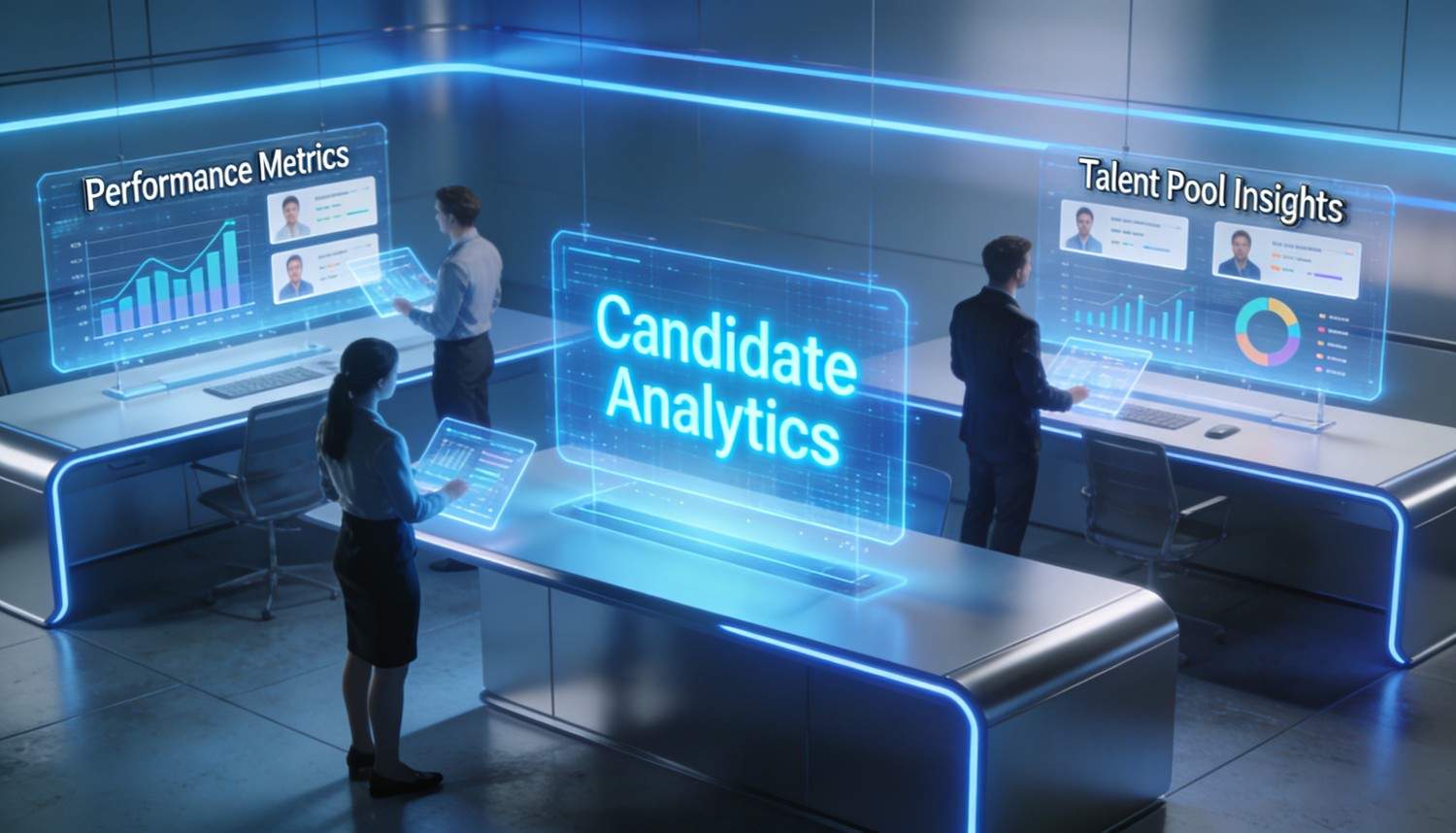
Built to Deliver Hiring ROI for Both Growing Teams and Enterprises Without Wasted Time or Cost.
Here’s what it does in practice:
- AI-powered video interviews. Candidates complete async video interviews on their own schedule. Automatically Analyzes, Scores, and Ranks Candidates for Faster Shortlisting.
- Automated candidate screening. Resume parsing and scoring happens in real time. Shortlists are ready within hours, not weeks.
- Interview scheduling automation. The painful back-and-forth over email? Gone. Candidates self-schedule, reminders go out automatically, no-shows get flagged.
- Structured assessments. Consistent evaluation criteria across candidates means more defensible hiring decisions and less interviewer-to-interviewer variation.
For startups especially, this levels the playing field. Good hr software for startups doesn’t just cut costs – it makes you look more professional to candidates, which matters when you’re competing with well-funded companies offering bigger salaries.
What AI Hiring Software Won’t Fix
Honestly, there are things AI simply can’t solve. Being clear about this matters.
If your employer brand is weak, AI doesn’t fix that. If your compensation is below market, no amount of faster screening changes the offer acceptance rate. And if the hiring manager takes three weeks to give feedback on a shortlist, the speed gains disappear anyway. The tool is only as fast as the slowest human in your process – and that part is frustrating when you’ve invested in the software but the internal process is still broken.
There’s also a real learning curve. Most teams see their biggest ROI after 3-6 months, once they’ve tuned the screening criteria and gotten hiring managers comfortable with AI-generated assessments. The first month often feels slower, not faster. That’s normal.
One more thing worth saying plainly: if your job description is vague or you’re sourcing from channels with poor fit, AI will just screen and rank bad candidates faster. Garbage in, garbage out.
Who Gets the Most Out of These Tools
High-volume hiring teams see the biggest wins almost immediately. If you’re hiring 10+ people a month, manual screening is a genuine operational bottleneck.
Companies in competitive talent markets benefit most from speed. When engineers have four offers to choose from, being first to move from application to interview is a real differentiator.
Startups scaling fast get disproportionate value from ai hiring software benefits because they often don’t have dedicated recruiters yet. One person handling everything gets much more leverage from automation than a 10-person recruiting team does.
If you’re a 5-person company hiring one person every six months, the ROI math is thinner. The benefits are real, but you need volume for them to show up clearly in your numbers.
Frequently Asked Questions
What are the main ai hiring software benefits for small businesses?
Speed and cost are the two biggest ones. Small businesses typically don’t have dedicated recruiters, so hiring tasks fall on founders or department heads who have other jobs to do. AI automates the most time-consuming parts – screening, scheduling, initial assessments – so you can run a professional hiring process without a full-time recruiter on payroll.
How do you calculate the ROI of AI hiring tools?
Start with your current cost-per-hire and time-to-hire. Multiply cost-per-hire by your annual headcount to get total annual recruiting spend. Estimate what a 25-30% reduction saves you. Add the productivity value of faster time-to-hire (roughly $500-$1,500 per day for unfilled skilled roles). Compare that total against the tool’s annual cost. Most teams see a positive ROI of ai hiring within 2-3 months.
Does AI hiring software actually reduce bias?
It can, if it’s set up correctly. Structured assessments based on job-relevant criteria reduce the inconsistency that comes from human reviewers who evaluate candidates differently depending on fatigue, mood, or implicit preferences. That said, AI trained on biased historical data can perpetuate that bias. Ask any vendor directly how they handle model auditing before you commit.
How long until results show up?
Speed improvements usually show within the first month – faster screening, faster scheduling, faster shortlists. Cost savings and quality-of-hire improvements take 3-6 months to appear clearly, once the system is calibrated and your team has adapted.
Is this worth it for occasional hiring?
If you’re hiring fewer than 10 people a year, the hard ROI is thin. It still makes sense if your open roles are senior or specialized (where a bad hire is very expensive), or if hiring is pulling key people away from their actual work. Otherwise, the investment is harder to justify.
What’s the difference between AI hiring software and a standard ATS?
A standard ATS is essentially a database – it stores applications, tracks pipeline stages, and manages communication. AI hiring software adds active intelligence: it screens and ranks candidates, conducts automated assessments, analyzes video interviews, and surfaces the strongest candidates without a human reviewing every single application.
Conclusion
AI hiring software reduces cost-per-hire by 25-35% on average, with some teams seeing more
Time-to-hire can drop from 40+ days to under 25 days with proper AI-assisted screening and scheduling
The strongest recruitment roi cases come from teams hiring 10+ people per year, particularly in competitive talent markets where speed wins candidates
Results take 3-6 months to fully materialize – the first month is setup, not savings
AI doesn’t fix weak employer branding, bad compensation, or slow internal processes – it amplifies whatever foundation you already have
The business case isn’t complicated. Your team is spending real money on manual processes that software handles faster and more consistently. The question isn’t whether to adopt – it’s which platform fits your hiring volume and workflow.