
















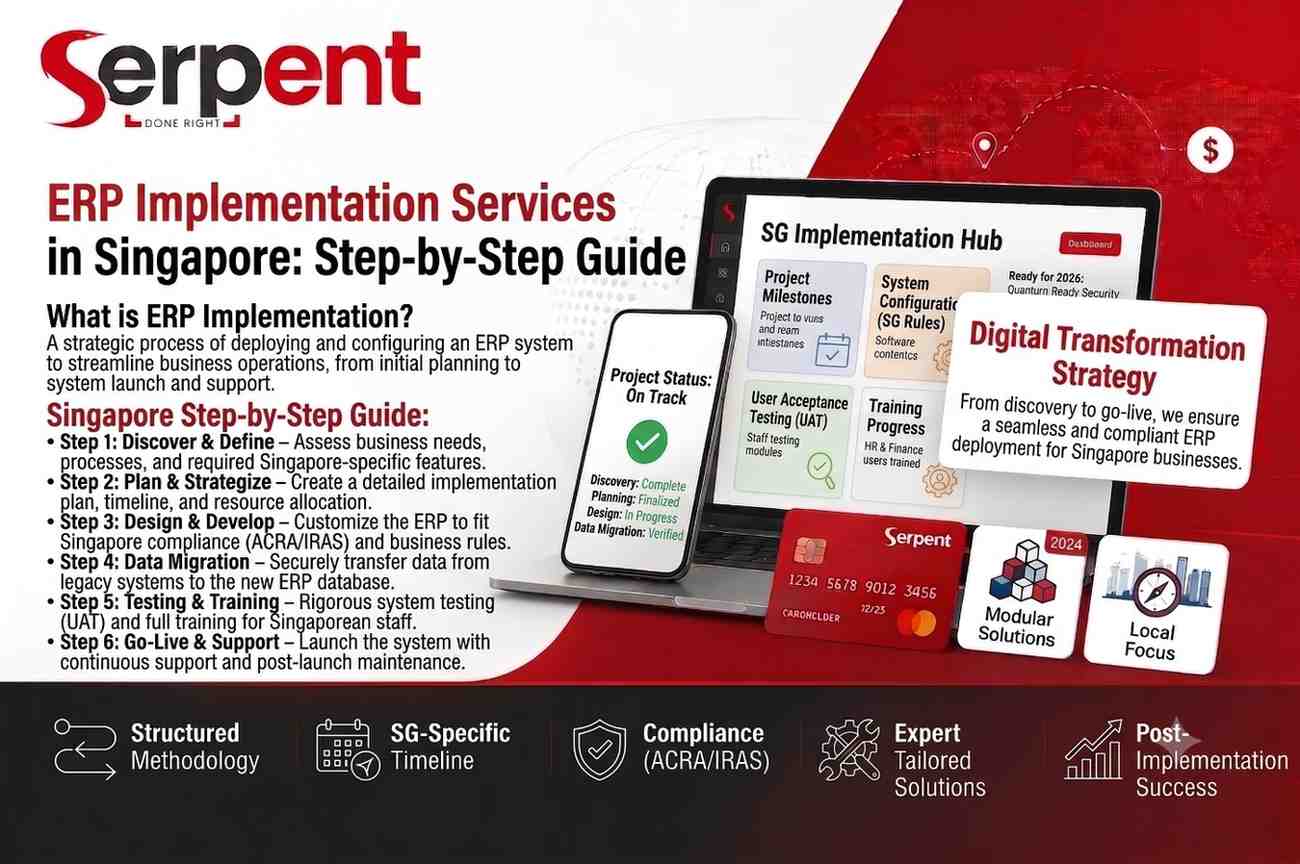
Business growth often reaches a point where spreadsheets, disconnected software, and manual processes begin slowing operations instead of supporting them. When that happens, implementing an Enterprise Resource Planning (ERP) system becomes more than a technology upgrade—it becomes a strategic business decision. Choosing the right ERP implementation services can help organizations streamline operations, improve visibility, and build a strong foundation for long-term growth.
Singapore has become one of Asia’s leading business hubs, with companies across manufacturing, retail, logistics, healthcare, and professional services embracing digital transformation. A well-planned ERP implementation enables businesses to stay competitive while improving operational efficiency and customer satisfaction.
Why ERP Implementation Is Essential for Modern Businesses
An ERP system connects multiple business functions into one centralized platform. Instead of managing finance, inventory, sales, procurement, and customer information separately, businesses gain a unified system that provides real-time insights.
Some of the biggest advantages include:
- Better decision-making through accurate data
- Improved collaboration across departments
- Reduced manual work and duplicate entries
- Faster reporting and financial visibility
- Enhanced customer service and operational efficiency
However, these benefits depend heavily on proper planning and execution, making professional ERP implementation services an essential investment.
Understanding ERP Implementation in Singapore
Companies operating in Singapore often face strict compliance requirements, growing customer expectations, and increasing competition. A successful ERP implementation Singapore project must align with local business regulations while remaining flexible enough to support future expansion.
Businesses that invest time in planning the implementation process typically experience fewer disruptions and achieve faster user adoption after deployment.
Step 1: Define Business Objectives
Every successful ERP project begins with clear goals.
Before selecting software or implementation partners, organizations should identify their biggest operational challenges.
Typical objectives include:
Improve Business Processes
Companies often seek to automate repetitive tasks and eliminate manual workflows.
Increase Operational Visibility
Real-time dashboards and centralized reporting provide management with accurate business insights.
Support Business Growth
Scalable ERP systems allow organizations to expand without replacing their software infrastructure.
Having measurable objectives helps ensure the implementation remains focused throughout the project.
Step 2: Choose the Right ERP Platform
Selecting the right ERP solution is just as important as selecting the implementation partner.
Businesses should evaluate factors such as:
Industry Compatibility
The software should support industry-specific workflows instead of forcing businesses to change successful processes.
Scalability
An ERP platform should grow alongside the organization without requiring major system replacements.
Integration Capabilities
Modern ERP software should integrate smoothly with CRM platforms, eCommerce systems, payment gateways, and third-party applications.
One of the most flexible solutions available today is Odoo implementation, which allows businesses to customize modules according to their operational requirements while maintaining scalability.
Step 3: Work with Experienced ERP Consultants
Technology alone does not guarantee project success.
Experienced consultants understand implementation challenges, risk management, business process optimization, and change management.
A trusted implementation partner typically provides:
- Business requirement analysis
- System configuration
- Data migration
- User training
- Testing
- Go-live support
- Post-implementation maintenance
Partnering with specialists significantly reduces implementation risks and accelerates project completion.
Step 4: Prepare and Clean Business Data
Data migration is one of the most overlooked phases of ERP implementation.
Outdated customer records, duplicate inventory information, and inconsistent financial data can negatively impact the new ERP environment.
Before migration, organizations should:
Remove Duplicate Records
Clean databases improve reporting accuracy.
Verify Data Accuracy
Ensure supplier, customer, product, and accounting information is up to date.
Standardize Data Formats
Consistent formatting reduces migration errors and improves system performance.
Well-prepared data contributes directly to a smoother implementation experience.
Step 5: Configure and Test the ERP System
Every business has unique workflows.
Rather than forcing employees to adapt to generic processes, ERP systems should be configured according to operational needs.
During this stage, implementation teams usually:
- Configure business modules
- Define user permissions
- Build automated workflows
- Integrate third-party applications
- Conduct user acceptance testing
Businesses looking for reliable ERP implementation services benefit from partners that emphasize testing before deployment to minimize operational disruptions.
Step 6: Train Employees Before Go-Live
Technology adoption depends on people.
Even the most advanced ERP solution delivers limited value if employees struggle to use it effectively.
Training should include:
Hands-On Practice
Employees become more confident through practical demonstrations rather than theoretical sessions.
Department-Specific Guidance
Finance, sales, warehouse, and HR teams require customized training based on their daily responsibilities.
Ongoing Support
Providing assistance after launch encourages faster adoption and minimizes resistance to change.
Why Odoo Implementation Is Gaining Popularity
Many businesses prefer Odoo implementation because of its modular architecture, affordability, and flexibility.
Unlike rigid ERP platforms, Odoo enables organizations to start with essential modules and expand functionality as business requirements evolve.
Popular Odoo modules include:
- Sales Management
- CRM
- Inventory
- Accounting
- Manufacturing
- Human Resources
- Project Management
This flexibility makes it an excellent choice for startups, SMEs, and growing enterprises across Singapore.
According to insights published by Forbes, organizations that embrace digital transformation and integrated business technologies are better positioned to improve efficiency, innovation, and long-term competitiveness.
Common ERP Implementation Challenges
Every ERP project presents unique challenges, but proper planning minimizes risks.
Some common obstacles include:
Lack of Clear Objectives
Without defined business goals, projects often exceed budgets and timelines.
Poor Change Management
Employees need proper communication and training to embrace new workflows.
Incomplete Data Migration
Migrating inaccurate information reduces the effectiveness of the new ERP system.
Choosing the Wrong Partner
Implementation expertise often determines project success more than software selection itself.
Selecting an experienced implementation partner helps organizations avoid costly mistakes while maximizing return on investment.
Implementing an ERP solution is one of the most valuable investments a growing business can make. From streamlining operations to improving decision-making, ERP systems provide the digital foundation required for sustainable growth.
Whether your organization is planning its first ERP deployment or upgrading an existing platform, choosing professional ERP implementation Singapore experts can significantly improve project outcomes. Combined with a flexible Odoo implementation strategy, businesses gain greater efficiency, scalability, and operational control.
If you’re ready to modernize your business processes, partnering with an experienced ERP implementation provider is the first step toward building a smarter, more connected, and future-ready organization.