












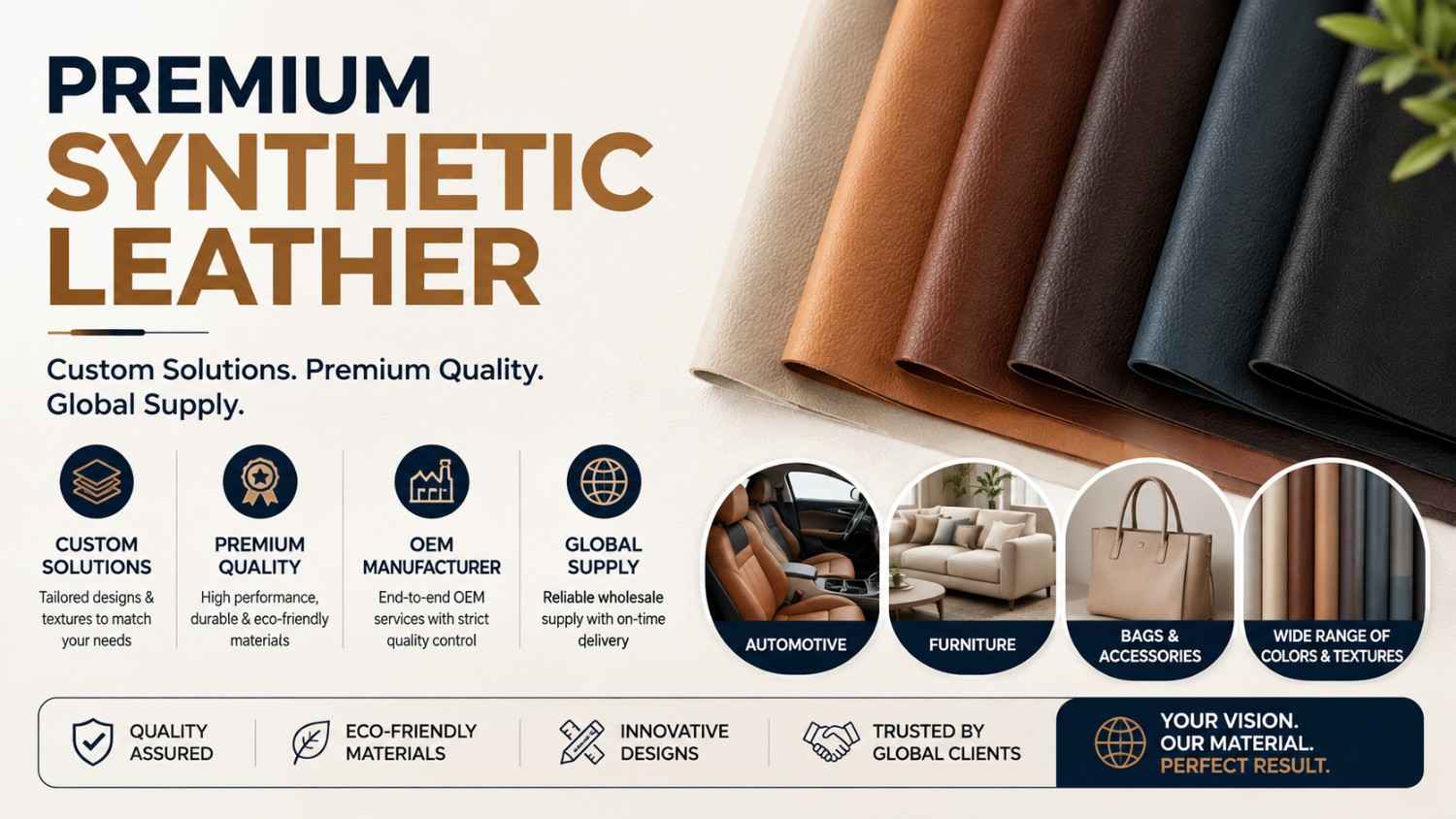
Asia-Pacific commands over 44.6 percent share of the global synthetic leather market, and within that region, Thailand has quietly built a manufacturing base capable of far more than commodity rolls, largely because its existing automotive and furniture export industries already demanded technically capable synthetic material production long before custom colour matching became a common request. That existing capability is precisely why more procurement teams are now searching for a custom synthetic leather supplier thailand partner rather than routing every custom order through more distant, higher-volume manufacturing hubs.
This guide covers what “custom” actually means in synthetic leather sourcing, what to expect on cost and lead time, the questions worth asking before committing to a custom production run, and why Thailand specifically has become a credible base for this kind of work.
What Customisation Actually Covers
“Custom synthetic leather” gets used loosely, and buyers benefit from knowing exactly which category of customisation they need before requesting quotes, since each level involves a different production process and minimum order commitment.
| Customisation Type | What Changes | Typical Complexity |
| Colour matching | Dye formulation adjusted to match a Pantone or physical swatch | Low to moderate, achievable with in-house dye labs |
| Embossed texture | Custom grain pattern applied via embossing roller or plate | Moderate, requires plate or roller tooling |
| Backing fabric substitution | Different weight, stretch, or fibre content backing | Moderate to high, affects the entire production line setup |
| Coating thickness or gsm change | Adjusted resin application to hit a specific weight target | Moderate, usually achievable within existing production tolerances |
| Fully bespoke formulation | New material structure, blend, or performance profile | High, closer to a joint development project than a standard order |
Buyers requesting a simple colour match should expect a very different timeline and minimum order quantity than buyers requesting a fully bespoke formulation, and suppliers who quote the same lead time for both are usually not being precise about what their production process actually involves.
Getting this classification right before requesting a quote also changes who at the supplier’s operation should be involved in the conversation. A colour match request usually only needs the dye lab and a production scheduler. A fully bespoke formulation request needs the technical or R&D team involved from the first conversation, since it is effectively a joint development project rather than a standard order, and a supplier who routes that kind of request through a generic sales contact without technical involvement is unlikely to deliver a formulation that actually performs as specified.
What Custom Orders Cost and How Long They Take
Custom colour matching typically adds a moderate premium over standard stock pricing, largely to cover dye lab time and a shorter production run than a standard colour benefits from. Embossed texture customisation adds tooling cost, which is sometimes charged as a one-time setup fee that gets amortised across future reorders once the roller or plate exists. Fully bespoke formulations involve the highest cost and longest lead time, since they typically require pilot batches and performance testing before a full production run is approved.
| Customisation Level | Typical Lead Time | Typical Minimum Order |
| Colour match, standard base material | 3 to 5 weeks | Low, often under 500 metres |
| Embossed texture, existing base material | 5 to 8 weeks | Moderate, roller or plate cost dependent |
| Backing or gsm change | 6 to 10 weeks | Moderate to high |
| Fully bespoke formulation | 10 to 16+ weeks | High, pilot batch plus production minimum |
Artificial leather production generally moves faster than natural leather tanning and finishing, which commonly runs ten to sixteen weeks even for standard orders, giving synthetic leather buyers a structural lead time advantage regardless of customisation level.
The Pilot Batch Step Most Buyers Underestimate
A pilot batch is where most custom synthetic leather projects either get validated or quietly go wrong. The purpose of a pilot run is to confirm that a specification approved on a small dye-lab sample actually holds up once produced at real production line speed and volume, since colour, texture, and coating thickness can all shift subtly between a lab sample and a full production roll. Buyers who skip the pilot stage and move straight from an approved swatch to a full production order are taking on risk that a short pilot run would have caught for a fraction of the cost.
A well-run pilot batch should be large enough to test the material through an actual downstream production step, whether that means a test-stitch run for a bag, an upholstery mock-up for furniture, or a wear trial for footwear, not just a colour comparison under studio lighting. Suppliers who offer a structured pilot batch process, with a defined sign-off step before the full order is released to production, are demonstrating that they have done this before and understand where custom orders typically go wrong.
Questions to Ask Before Committing to a Custom Run
A custom order locks in tooling cost, dye formulation records, and often a supplier relationship that is expensive to unwind if the first run does not meet specification. Front-loading the right questions protects that investment.
- Will you retain the dye formulation and tooling for future reorders, or does each custom run start from scratch
- What is the minimum reorder quantity once the custom specification is established
- How many pilot samples are included before the production run is approved, and what happens if the first pilot does not match
- What tolerance do you guarantee for colour and texture consistency across a full production run, not just the approved sample
- Can the custom specification be documented in a way that transfers if we need a second supplier for capacity reasons
Suppliers who answer these clearly, with specific numbers and documented processes, are signalling that custom work is a routine part of their operation rather than a favour done outside their normal workflow.
Why Thailand Specifically Works for Custom Orders
Thailand’s synthetic leather sector developed alongside its automotive assembly and furniture export industries, both of which have required custom colour matching and technical specification work for decades, well before it became a mainstream request from fashion and consumer goods buyers. That existing technical base means Thai suppliers are frequently better equipped for genuine custom work than newer entrants in markets where synthetic leather production scaled purely around commodity colour and finish options.
Geography adds a practical advantage as well. Buyers running a pilot batch benefit from Thailand’s proximity to major ASEAN manufacturing clusters in Vietnam and Indonesia, meaning a custom material developed in Bangkok can reach a cut-and-sew factory elsewhere in the region faster than material shipped from further afield. For buyers who need to iterate on a specification with a factory partner before locking in a full production order, that shorter feedback loop between material supplier and manufacturing partner meaningfully compresses development time.
Thailand’s trade position adds a further advantage for buyers planning to distribute across the region after production. Materials sourced and processed within Thailand can move under ASEAN free trade terms to finished-goods manufacturers elsewhere in the bloc, which matters for brands running a multi-country production footprint rather than a single factory relationship. Combined with an established base of automotive and furniture technical expertise, this makes Thailand a credible custom sourcing option rather than simply a lower-cost alternative to more established manufacturing hubs.
Where Custom Synthetic Leather Gets Used
Automotive interior programmes frequently require custom colour matching to align with a specific trim package or brand colour palette, along with embossed grain patterns that match a model’s design language. Furniture brands commissioning a signature collection often need a bespoke texture or colourway that differentiates the line from competitors sourcing generic stock materials. Marine and outdoor upholstery applications sometimes require a custom coating formulation to hit specific UV and hydrolysis resistance targets beyond what a standard product line offers. Export brands building a private label product line frequently start with a custom colour match to a specific Pantone reference, since consistent brand colour across a product range matters more to retail buyers than material origin. Hospitality and interior design projects, from hotel seating to retail fixtures, also commonly require custom colour and texture work to match an architect’s or designer’s specification exactly, a category of demand that has grown alongside Southeast Asia’s expanding hospitality construction pipeline.
Building a Custom Sourcing Relationship That Lasts
Custom synthetic leather sourcing rewards buyers who treat the first order as the start of a documented relationship rather than a one-off transaction. Retained dye formulations, clear reorder minimums, and transferable technical specifications protect a buyer’s ability to scale or diversify sourcing later without starting the development process over, which matters far more once a product line depends on that exact colour and texture matching consistently for years.
For teams evaluating Thailand as part of a broader sourcing strategy, a Bangkok-based catalogue of vegan leather b2b supplier options with in-house customisation capability is a practical starting point for a pilot order before committing to a full production run.