
















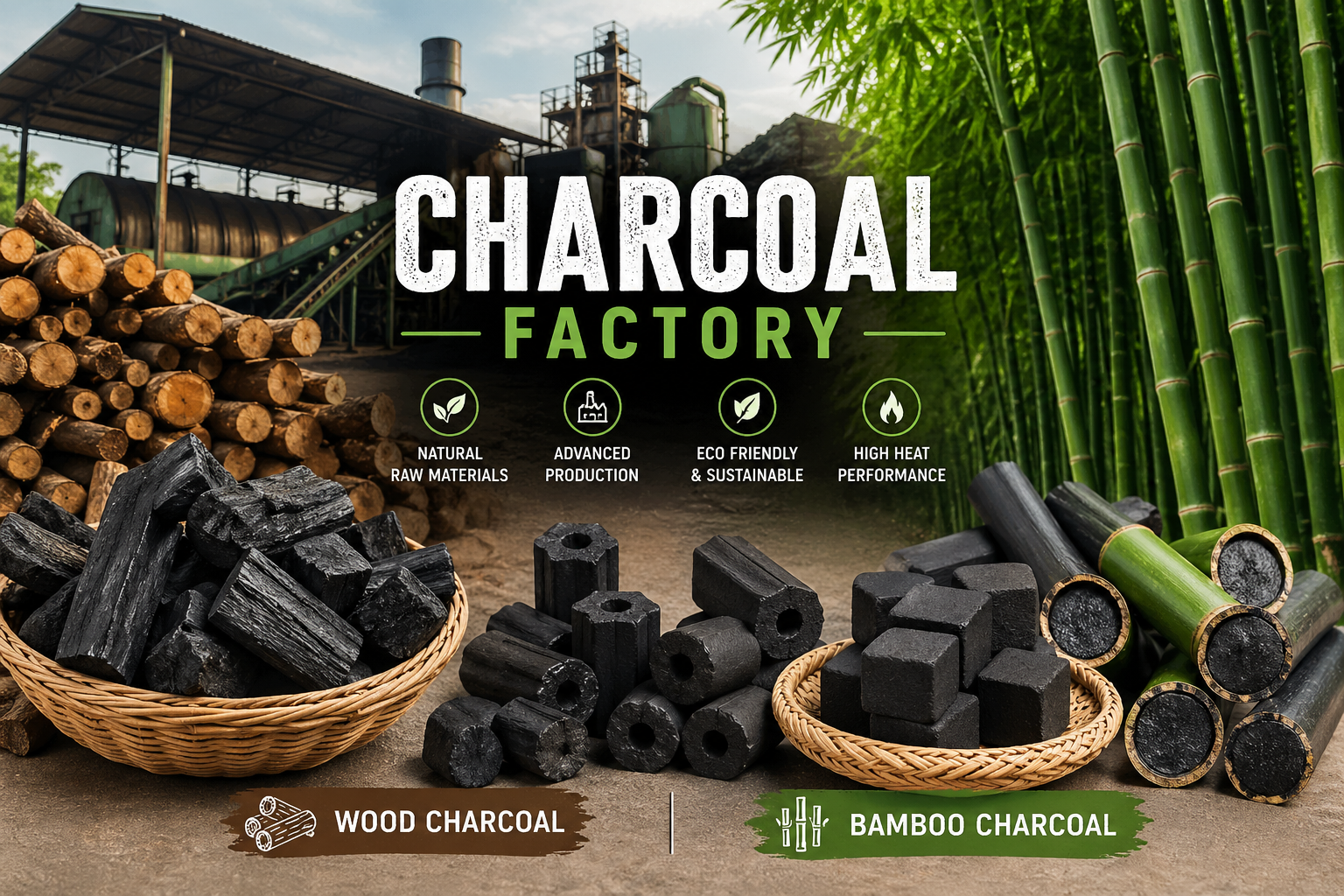
The global charcoal market is larger, more resilient, and more diverse than most people realise. Across the Middle East, Europe, Southeast Asia, and North America, demand for high-quality natural charcoal — for shisha lounges, restaurants, supermarket retail, and outdoor hospitality — continues to grow year on year. And unlike many commodity businesses, charcoal distribution has a surprisingly wide margin opportunity for anyone willing to build a proper supply chain from the factory outward.
This guide is written for entrepreneurs, importers, and businesspeople who are seriously considering entering the charcoal distribution space — or who are already in it but are buying from the wrong source and leaving significant money on the table. We will walk through every stage of building a credible, profitable operation: how to choose your market, how to find the right charcoal distributor and supplier partner, how to structure your first container order, and how to grow from a single SKU into a multi-channel business with real brand equity.
Why the Charcoal Distribution Business Is More Attractive Than It Looks
Most people think of charcoal as a seasonal product — something sold in supermarkets between May and August. That perception is shaped by living in a temperate climate. The reality of the global charcoal market is very different.
Shisha lounges operate 365 days a year. High-end restaurants with live-fire cooking positions — yakitori, robata, asado, live-fire European concepts — consume charcoal every single service. Industrial buyers, food manufacturers using charcoal in processing, and export markets across the Middle East and Southeast Asia run on continuous supply cycles that have nothing to do with Western BBQ seasonality.
For a distributor who builds customer relationships across multiple segments — hospitality, food service, retail, and export — the business generates revenue every month of the year. Seasonal peaks in retail actually benefit a well-structured distributor by lifting volume without increasing fixed costs.
The entry barriers are also lower than many import businesses. Charcoal is a non-perishable commodity. It does not require cold chain logistics, specialised storage, or complex regulatory approval in most markets. A standard warehouse, a reliable factory relationship, and a basic freight forwarding arrangement are sufficient to start.
Step 1: Decide Which Market Segments You Will Serve
Before you spend a single dollar on product, you need to map your customer landscape. The four main distribution channels for charcoal each have different product requirements, buying cycles, and margin structures:
Hospitality — Shisha Lounges and Hookah Bars
This is the highest-frequency, most quality-sensitive segment. Lounge operators buy charcoal every week. They care deeply about consistency — a batch that burns differently from the last batch creates operational chaos. They need natural, additive-free charcoal in cube or hexagonal format, and they are willing to pay for documented quality. If you win a lounge account with reliable supply, you keep it for years.
Your anchor product for this channel is wholesale hookah charcoal sourced directly from a manufacturer that produces A-Grade bamboo or coconut shell charcoal with a Certificate of Analysis per batch.
Food Service — Restaurants and Catering
Restaurant buyers care about burn time, heat consistency, and cost per service. They are less concerned with packaging presentation and more focused on operational reliability. This channel offers excellent repeat business because chefs and kitchen managers, once satisfied with a product, rarely switch suppliers. Your entry product here is bulk charcoal for restaurants — typically B or A-Grade bamboo charcoal in master carton bulk, not retail-packed.
Retail — Supermarkets, Garden Centres, Convenience Stores
Retail is the most visible channel but requires the most investment in packaging and category management. Buyers at supermarkets and garden centres want a branded, shelf-ready product. This is where private label charcoal for supermarkets becomes your competitive weapon — a branded own-label product that you own rather than a commodity anyone can source.
Export and Wholesale
Some distributors act as a middle layer — buying containers direct from factory and breaking them down for smaller importers, wholesalers, or regional distributors who cannot meet the MOQ alone. This is a lower-margin model but generates volume, and it is a natural entry point for distributors who have strong logistics infrastructure but are still building their end-customer base.
Step 2: Find the Right Factory Partner — This Is the Most Important Decision You Will Make
Your factory relationship determines your product quality, your cost structure, your documentation, and your ability to deliver on promises to customers. A bad factory partner — one that ships inconsistent product, cannot provide proper documentation, or disappears when problems arise — will destroy your business faster than any market condition.
Here is what separates a genuine manufacturing partner from a broker or trading company:
• They own and operate their own production facility — they are not sourcing from third-party kilns.
• They issue a Certificate of Analysis for every production batch, not just a generic product spec sheet.
• They have established export documentation: phytosanitary certificate, certificate of origin, fumigation certificate, commercial invoice, packing list, and bill of lading.
• They offer custom packaging and private label production from the same production run as standard product.
• They can take you through their manufacturing process and welcome factory visits or audits.
• They have active supply relationships in your target market or nearby regions — evidence of export experience.
The charcoal distributor and supplier relationship you build with a direct manufacturer will give you access to factory-level pricing — typically 30–50% below what you would pay buying through a local wholesaler or trading company. That margin difference is your business.
Step 3: Understand Your Container Economics Before You Order
Container economics are the foundation of a charcoal distribution business. Every pricing decision, every customer offer, and every margin calculation flows from your landed cost per kilogram. Get this right and your business is profitable from day one. Get it wrong and you are subsidising your customers at your own expense.
A standard 20-foot full container load (FCL) holds approximately 18–20 tonnes of charcoal depending on density and packaging format. Your full landed cost per tonne includes:
1. Ex-factory price per tonne (this is your starting point — the number you negotiate directly with the manufacturer).
2. Export documentation and inspection fees at origin (typically a fixed cost per container).
3. Sea freight from the port of loading to your destination port (get three quotes from freight forwarders).
4. Import duties and customs clearance at your end (varies significantly by country and HS code — verify before ordering).
5. Last-mile delivery from port to your warehouse.
6. Warehousing and handling costs while the product sits in your facility.
Once you have that total landed cost per kg, your gross margin is the spread between that figure and your selling price into each channel. Restaurants buying bulk charcoal for restaurants in volume typically pay 20–35% above your landed cost. Retail accounts, depending on category terms, will expect slightly tighter margins in exchange for volume and consistency.
Step 4: Build Your Customer Pipeline Before Your Inventory Arrives
This is the step most first-time distributors skip — and it is the one that causes cash flow problems in the first three months. Production and shipping from a factory in China or Southeast Asia takes 35–50 days from order to arrival. That is your sales window.
In the weeks between placing your container order and taking delivery, you should be doing the following:
• Visiting potential shisha lounge and restaurant accounts with samples. Use the sample pack from your manufacturer to demonstrate product quality before committing to volume.
• Negotiating first supply agreements with your target accounts. Even a verbal commitment from three or four customers de-risks your first container significantly.
• Building your pricing sheet for each channel — hospitality, food service, retail, and export — with clear MOQ, delivery terms, and payment conditions.
• Confirming your logistics setup: warehouse space, delivery vehicle or third-party logistics arrangement, and invoicing system.
Step 5: Add Private Label as Early as Possible
Many distributors treat private label as something to consider “when the business is bigger.” This is a mistake. A branded product is worth meaningfully more per kilogram than an unbranded commodity. It creates customer loyalty — a retailer or lounge that has your branded product on their floor is invested in your relationship in a way that a commodity buyer never is.
The incremental cost of adding custom packaging — your logo and design on inner boxes and master cartons — to a container order is typically less than 5% of the total shipment value. The incremental price premium you can charge for a branded product versus a commodity is often 15–25%.
If you are entering the retail channel with private label charcoal for supermarkets or building a hospitality brand, discuss packaging options with your factory from your very first conversation. The factory design team can help develop packaging artwork. The earlier you start, the sooner you own a product rather than just reselling someone else’s.
Step 6: Think Multi-Category From the Start
The most profitable charcoal distributors are not one-product businesses. They serve lounges with hookah charcoal, restaurants with cooking charcoal, supermarkets with branded retail packs, and sometimes export accounts with commodity container volume — all from relationships with the same one or two factory partners.
This means your pitch to a new customer is not “I sell BBQ charcoal.” It is “I can supply your full charcoal category — shisha, cooking, and retail — on consistent specification, with full documentation, delivered to your door.” That is a different conversation, and it is the one that builds lasting wholesale relationships.
Start by sourcing wholesale BBQ charcoal and hookah charcoal from the same manufacturer. Two product lines, one container, one logistics relationship, one documentation package. Then expand as your customer base grows.
Final Thoughts: Distribution Is a Relationship Business
The charcoal distribution business rewards consistency, reliability, and trust more than any other factor. Your customers — lounge owners, restaurant chefs, retail buyers — are not just buying charcoal. They are buying confidence that their supply will arrive on time, on spec, and with no surprises.
That confidence starts at the factory. A direct, transparent relationship with a manufacturer that takes quality control seriously, provides documentation as standard, and treats your business as a long-term partnership rather than a transaction is the foundation everything else is built on.
Take the time to find the right factory. Request samples. Ask hard questions about documentation and production process. And build your customer relationships before your first container lands.
Start your charcoal distribution business with a verified manufacturer: thecharcoalfactory.com/charcoal-distributor-supplier