
















By Sunny Banerjee
There is a particular kind of silence that defines many contemporary Indian homes. It is not the silence of calm, but of completion—of spaces resolved so thoroughly that nothing within them is left to unfold. Materials are curated, surfaces perfected, and lighting engineered with precision; yet once the initial act of seeing gives way to inhabiting, a limitation becomes apparent. The space does not evolve. It remains, in every meaningful sense, as it was first composed.
For a generation navigating digital saturation, urban compression, and rising cognitive fatigue, this immobility no longer reads as neutrality. It registers instead as absence. The issue is not aesthetic inadequacy but temporal emptiness: interiors that exist perfectly in a single moment and offer little beyond it. What is emerging in response is not a stylistic shift, but a reconsideration of what a designed space is expected to do. Across India’s metropolitan homes, one increasingly encounters environments that are not merely composed, but capable of change—spaces in which design begins to behave.
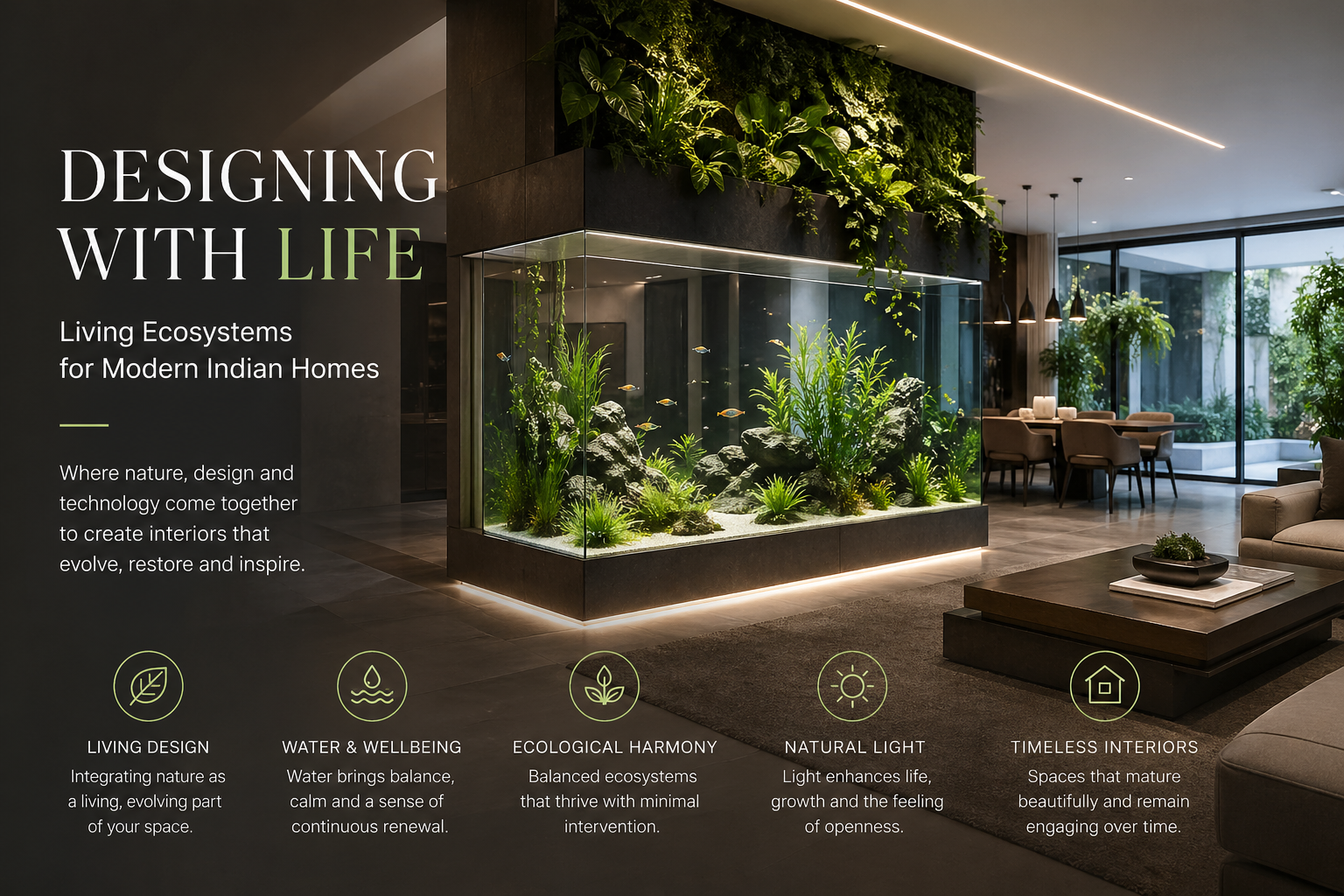
At the centre of this transition lies the integration of living ecosystems within the architecture of the home. These are often mistaken for familiar elements—aquariums, planted installations, water features—but the resemblance is superficial. What distinguishes the present movement is not the presence of these elements, but the manner in which they are conceived. They are no longer additions to a completed interior; they are systems around which the interior itself is organised.
To understand the significance of this shift, it is necessary to recognise the limits of the model it begins to replace. Interior design has long operated through the logic of arrangement: objects selected, positioned, and layered to achieve visual harmony. However sophisticated, the resulting composition is static. It does not evolve because it is not designed to. Stability has traditionally been equated with calm, permanence with refinement. Yet stability, extended indefinitely, renders time irrelevant within the space. Nothing progresses, adapts, or responds.
Human environments that are experienced as restorative rarely exhibit this kind of stillness. They are characterised instead by subtle, continuous variation—movement that is coherent rather than chaotic, legible rather than abrupt. The mind engages with such environments without strain; attention is held, but not captured, a condition long examined within environmental psychology. It is precisely this quality that living ecosystems reintroduce into the interior.
When a space incorporates a functioning biological system, it acquires a temporal dimension that cannot be simulated through materials alone. Light becomes participatory, influencing growth and behaviour rather than merely illuminating form. Water introduces movement that is constant yet unpredictable, altering reflections and depth from one moment to the next. Plant life adapts, responding to conditions that are themselves in flux. The result is not visual complexity, but experiential continuity—a space that reveals itself gradually through duration rather than instant comprehension.
Among these elements, water occupies a particularly consequential role. Unlike solid materials, which assert form through stability, water resists fixation. It shifts, refracts, and absorbs, altering the behaviour of light and softening the boundaries of space. Depth emerges where there was once flatness; edges lose their rigidity; visual processing slows. A room that incorporates water is not merely more dynamic in appearance—it is different in how it is perceived and inhabited. It introduces rhythm into an otherwise static environment, offering a counterpoint to the acceleration that characterises contemporary life.
Yet the presence of water or plant life is not in itself sufficient. What distinguishes a living ecosystem from a decorative installation is its underlying structure. These systems are governed by interdependent relationships—between light and growth, nutrients and stability, biological load and resilience. The equilibrium they produce is neither immediate nor guaranteed. To design with life is therefore to engage with processes that extend beyond the visual, requiring a form of ecological intelligence that understands how systems sustain themselves over time.
It is here that superficial interpretations of “nature in interiors” tend to falter. They reproduce the appearance of ecosystems without accounting for their internal logic, achieving initial visual success but eventual instability. The difference between an ecosystem that endures and one that deteriorates lies not in how it looks, but in how it is constructed and maintained.
In India, this transition is shaped by conditions that are both shared and locally specific. Across metropolitan contexts—Mumbai’s spatial compression, Bengaluru’s climatic expectations, Hyderabad’s rapid urban expansion, Chennai’s environmental variability—interiors operate within constraints that leave little room for approximation. Water quality is inconsistent, temperature fluctuations are pronounced, and built environments are increasingly sealed. Under such conditions, the integration of living systems demands calibration rather than intuition.
What is emerging, therefore, is not a stylistic trend but a technically grounded approach to design. Living ecosystems are being treated as systems to be engineered rather than elements to be arranged. Practices operating in this space, including firms such as ProHobby New Delhi, are part of a broader shift toward ecological design intelligence, where success is measured not by immediate visual impact but by long-term stability and behavioural coherence.
This shift is also altering how value is perceived within the home. Traditional notions of luxury have relied on immediacy—materials that impress instantly, compositions that photograph well, finishes that signal refinement. Living ecosystems operate on a different timeline. They evolve, mature, and reward attention over time; their value is not exhausted in a first impression but accumulates through continued engagement. In this sense, they align with a broader cultural movement away from display toward experience, from static ownership toward dynamic interaction.
To incorporate such a system into the home is not simply to add a feature, but to alter the nature of the environment itself. It introduces continuity into spaces that would otherwise remain fixed, reintroducing a degree of unpredictability and growth into interiors long optimised for control. The implications extend beyond aesthetics, shaping how time is experienced, how attention is restored, and how occupants relate to their surroundings on a daily basis.
If this trajectory continues, the interiors that come to define the next decade will not be those that achieve the highest degree of visual perfection, but those that achieve balance—spaces in which change is present yet measured, systems active yet stable. In that transition from static arrangement to dynamic equilibrium, interior design in India may move toward something more enduring than style:
a way of designing with life itself.
Author Bio
Sunny Banerjee is associated with ProHobby™, an ecological systems design practice based in Delhi and operating across India’s metropolitan regions. The firm specialises in aquatic and hybrid living environments that integrate biological stability with contemporary interior architecture.